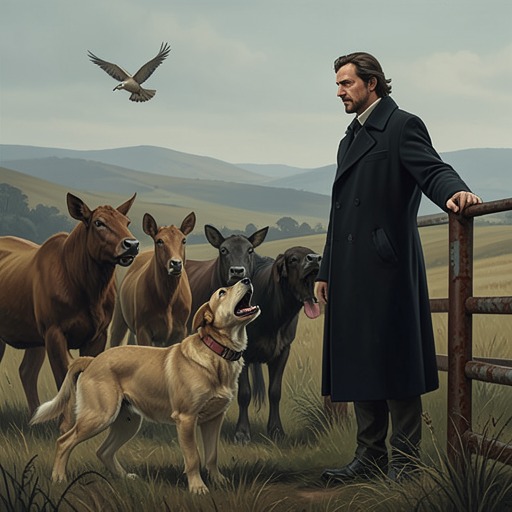
Animal imagery and the killer’s ritualized staging
The Chemistry of DeathAnimal imagery and the killer’s ritualized staging make animals serve two different roles in the Manham investigation: their natural activity helps establish how bodies have changed, while dead animals and animal remains may carry deliberate messages. The distinction matters. Insects and soil offer evidence that can be assessed, however provisionally; a dead hare or a set of swan wings invites interpretation, but does not by itself establish who placed it or why.
Natural processes and forensic evidence
The investigation reads insect activity as a changing biological sequence rather than as a fixed clock. At the site where Sally Palmer’s body was found, blowfly larvae were the principal evidence. Their age, the absence of empty pupal cases, and the flies’ life cycle supported an initial estimate of roughly one to two weeks since death. On closer inspection, the brittle, crumbly adipocere and the condition of the vegetation were also consistent with relatively rapid decomposition in hot weather. The estimate remained provisional: the available signs suggested perhaps nine or ten days, but could not supply an exact time. A later comparison with a dead dog illustrates why no single animal or insect sign could settle the timeline. Some pupae there seemed close to hatching, and beetles were present, although few. The forensic explanation was that flies and maggots tend to arrive earlier, while beetles become more prominent as decay advances. Since beetles had not been observed at the place where Sally Palmer was found, the contrast was potentially relevant but not decisive; the investigator stressed that beetles were a less reliable indicator and that other variables mattered. Animal life in this sense is not a decorative backdrop: it is part of the material environment from which investigators reconstruct events, with limits that must be made explicit.
Possible markers before the murders
The possibility that the killer used animals to mark or warn his victims emerges from separate reports. A witness said Sally Palmer had been upset by a dead stoat left on her doorstep and had regarded it as a sick joke. Lyn Metcalf had told her husband that she found a dead hare in the woods the day before she disappeared. The hare might have been killed by a dog or fox, and the stoat might have been left by children; neither report proved the killer’s involvement. Still, alongside the birds associated with the crimes, the incidents raised the possibility that animal deaths preceded the attacks rather than merely accompanying them. The bird imagery was more conspicuous. Swan wings were found with Sally Palmer’s body, and a mallard had been tied to a stone on the morning Lyn Metcalf disappeared. Mackenzie considered whether dead animals, like birds, could be part of the killer’s signature, or even a kind of claim on future victims. The idea remained a hypothesis, not an established account of how the killer selected or tracked anyone. The narrative keeps that uncertainty in view: coincidences are possible, but the recurrence makes coincidence harder to accept without further evidence.
Staging and personal associations
A possible personal reference sharpens the meaning of the swan wings. A local newsletter reported that Sally Palmer valued living close to nature because it fed her imagination, and described her creative response through the image of flight and wings. The timing of that public remark, followed by the use of swan wings in the staging of her body, suggested a connection to the investigator. Mackenzie would not treat the short newsletter item as proof. Its suggestiveness is real, but it cannot establish that the killer saw the article or chose the wings in response to it. The animal imagery associated with Lyn Metcalf points toward a different private circumstance. Her medical notes showed that she and Marcus Metcalf were trying to start a family and considering fertility treatment. Baby rabbits had been placed inside her body, a detail that led the investigators to connect the staging to her hope of becoming pregnant. A pregnancy testing kit was later found hidden in a drawer in the couple’s bedroom, with a receipt dated the day before Lyn disappeared. That discovery made the rabbits’ possible meaning more pointed, but did not, on its own, explain how the killer learned of her circumstances or prove what he intended the image to mean. The staging thus appears individualized rather than simply repeated: the swan imagery may echo Sally Palmer’s public association with wings, while the rabbits evoke the family Lyn and Marcus hoped to have. There is also a significant difference between the two crime scenes. Lyn Metcalf’s body had no swan wings. Instead, the later discovery of the rabbits offered another disturbing animal association, while the absence of the earlier emblem showed that the killer’s staging was not a mechanically identical signature each time. Repeated animal imagery and variation coexist: the scenes invite comparison, but not a simple formula that would identify every act or reveal its motive.
Warnings, concealment, and consequence
A dead fox found by Tina extends the pattern into the events surrounding Jenny Hammond’s abduction. When Mackenzie asked whether Tina or Jenny had encountered dead birds or animals, Tina initially said no, then remembered the fox almost as an afterthought. She had not understood its possible significance. In retrospect, the discovery looked like a warning that had gone unnoticed, although the evidence does not establish who killed the fox or whether it was deliberately connected to the abduction. The gap between an incident occurring and its meaning being recognized becomes part of the danger: what might have served as a warning could not help anyone who did not know to read it. The police had withheld information about the mutilated animals. Mackenzie said those details could not be released, while the investigator questioned whether the public should have been alerted if animals were being used to mark victims in advance. After the dead fox surfaced in conversation, that earlier decision acquired a sharper consequence, though responsibility was not presented as Mackenzie’s alone. The animal signs therefore function both as clues within the investigation and as information whose circulation is contested. Their meaning remains uncertain, but withholding it may leave people unable to connect a seemingly isolated discovery to a larger threat.
Narrative significance
The motif depends on a tension between evidence and interpretation. Insects, pupae, soil, and vegetation can support a cautious reconstruction of time and conditions; a dead animal may instead be an ambiguous sign whose force emerges only beside other events. The birds and mammals do not speak for themselves, and the investigators cannot confidently assign every death to the killer. Yet their recurrence changes how ordinary encounters with wildlife are read: a stoat at a doorstep, a hare in the woods, or a fox discovered by Tina can acquire retrospective significance without becoming conclusive proof. That uncertainty gives animal imagery its narrative force. It links the killer’s staged scenes to details of victims’ lives, while also exposing how easily a potential warning can be dismissed or missed. Nature is at once an active forensic environment and the medium through which the killer may impose a human pattern. The investigation must distinguish those roles without pretending that every animal death has a decipherable message.